
The Rollator
The Rollator Engineered for Kenyan conditions. Proven through real-world pilot use.
The rollator was selected after international research and then assessed through two successful pilot programmes carried out via APDK, with feedback from users and rehabilitation professionals. Every feature has a purpose.
Pilot in practice
- Tested by two real users in Kenya
- One pilot lasting more than two years
- Continuous feedback from the users
Side profile of the BHK pilot rollator — lightweight frame, cable brakes and polyurethane wheels.
A lightweight rollator built for Kenyan conditions — tough enough for uneven outdoor terrain, yet compact and manoeuvrable indoors. Large wheels, durable construction, adjustable handle height, mechanical brakes, integrated seat and basket, and a foldable aluminium frame make it suitable for both urban and uneven terrain.
Interactive specifications
Frame weight: ≈ 8.7 – 8.9 kg
Lightweight aluminium frame designed for easy lifting into vehicles.
Investor at a glance
Key figures for investors and partners
A quick overview of the market, the validation behind the product and where BHK Solutions Kenya is heading.
People in Kenya with documented mobility challenges — a demand that will only grow.
Continuous outdoor use on unpaved terrain; frame, brakes and wheels in very good condition.
Five-year projection for rollators delivered across Kenya and East Africa.
Pilot programmes with APDK completed; KEBS certification and commercial launch next.
Figures are based on BHK Solutions Kenya's pilot documentation and market research. Projections are goals, not guarantees.
Our Rollator
The Rollator That Validated Our Vision
The rollator shown here is the model donated to the Association for the Physically Disabled of Kenya (APDK) and used throughout our pilot programme.
It has been evaluated in real-world conditions by APDK staff and users, providing operational and technical feedback. The pilot programmes indicate that a lightweight rollator, built for demanding Kenyan conditions, can improve mobility and independence for elderly people and others with walking difficulties.
Over more than two years, BHK Solutions Kenya has identified, evaluated and pilot-tested a rollator suited to demanding Kenyan conditions. Combining quality, durability and an affordable price is difficult — the large high-quality wheels alone can cost as much as an entire low-cost rollator elsewhere. We have deliberately prioritised durability and real-world performance rather than the cheapest available product. KEBS approval will be obtained before commercial launch.
Why the pilot programmes matter
- Two successful pilot programmes completed via APDK.
- Validated demand for rollators suited to Kenyan conditions.
- Provides technical feedback for the final BHK Solutions model.
- Reduces product development risk before market launch.
- Demonstrates a practical, validated solution rather than a theoretical concept.
- Confirms that the frame, brakes and wheels remain in near-new condition after nearly two years of outdoor use.
Product Selected
After extensive international research and evaluation, BHK Solutions selected a durable outdoor-adapted rollator suitable for Kenyan conditions.
APDK Pilot Launched
A rollator was donated to the Association for the Physically Disabled of Kenya (APDK) to begin a structured pilot programme.
Successful Pilot
Two real-world pilots were conducted in Kenya, including one with nearly two years of continuous use, providing valuable user and operational feedback.
Pilot Validated
The pilots confirmed improved mobility, independence, and usability under real-world outdoor conditions. APDK rehabilitation professionals evaluated the product positively.
KEBS Certification
The commercial version is now being adapted for the Kenyan market and will undergo KEBS certification before commercial launch.
Scaling Across Kenya
Following certification, BHK Solutions Kenya will begin supplying outdoor-adapted rollators to rehabilitation organisations, healthcare providers, NGOs, distributors, and families across Kenya, with planned expansion into neighbouring East African markets.
Key figures from the pilot
2+ years
Continuous outdoor use documented from June 2024 to June 2026.
2 real users
Adult user (85) and child user (8) across different age groups and terrain.
Continuous movement
Ian pushed the rollator across grass and paths without lifting — a clear change from his previous walker.
APDK + family
Professional evaluation by APDK rehabilitation staff and independent home-use follow-up by caregivers.
For investors and healthcare partners
Request a detailed pilot brief.
Get the pilot brief for your organisation or fund.
Send a short request and we will reply with the pilot summary, evaluation details, market context and next steps — tailored for healthcare institutions, rehabilitation programmes, NGOs and investors.
Pilot in practice
Ian's story — from first hour to daily use
Pilot evidence — two users
Two users. Two age groups. One consistent result.
Pricila, 85
Pilot one · adult user
- More than two years of daily outdoor use, documented as of June 2026
- Ordinary daily life in Kenya — not a clinic or a laboratory
- Wheels, brakes and frame in very good condition after two years
Ian, 8
Pilot two · child user
- First hour at APDK, observed by rehabilitation professionals — rollator donated for the pilot, not purchased
- Continued daily use at home on uneven, unpaved ground, grass and paths
- Independent use documented by his mother Peris — no staff present
Results are qualitative and observational, from BHK Solutions' pilot documentation — not a controlled clinical trial.
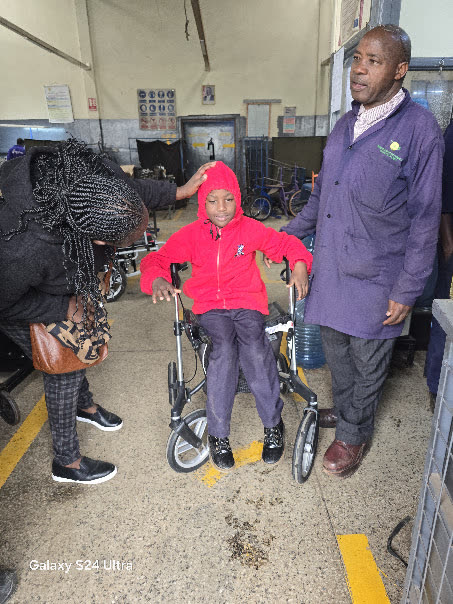
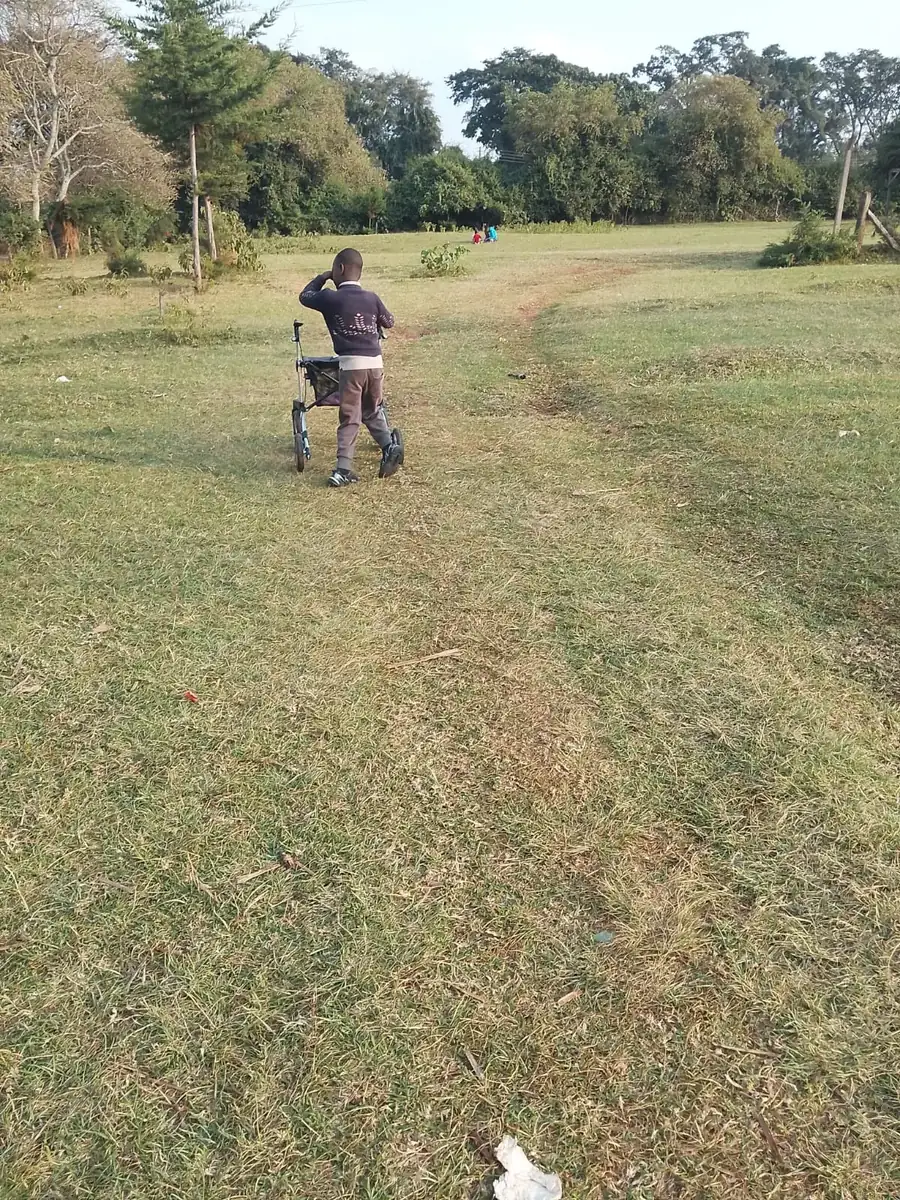
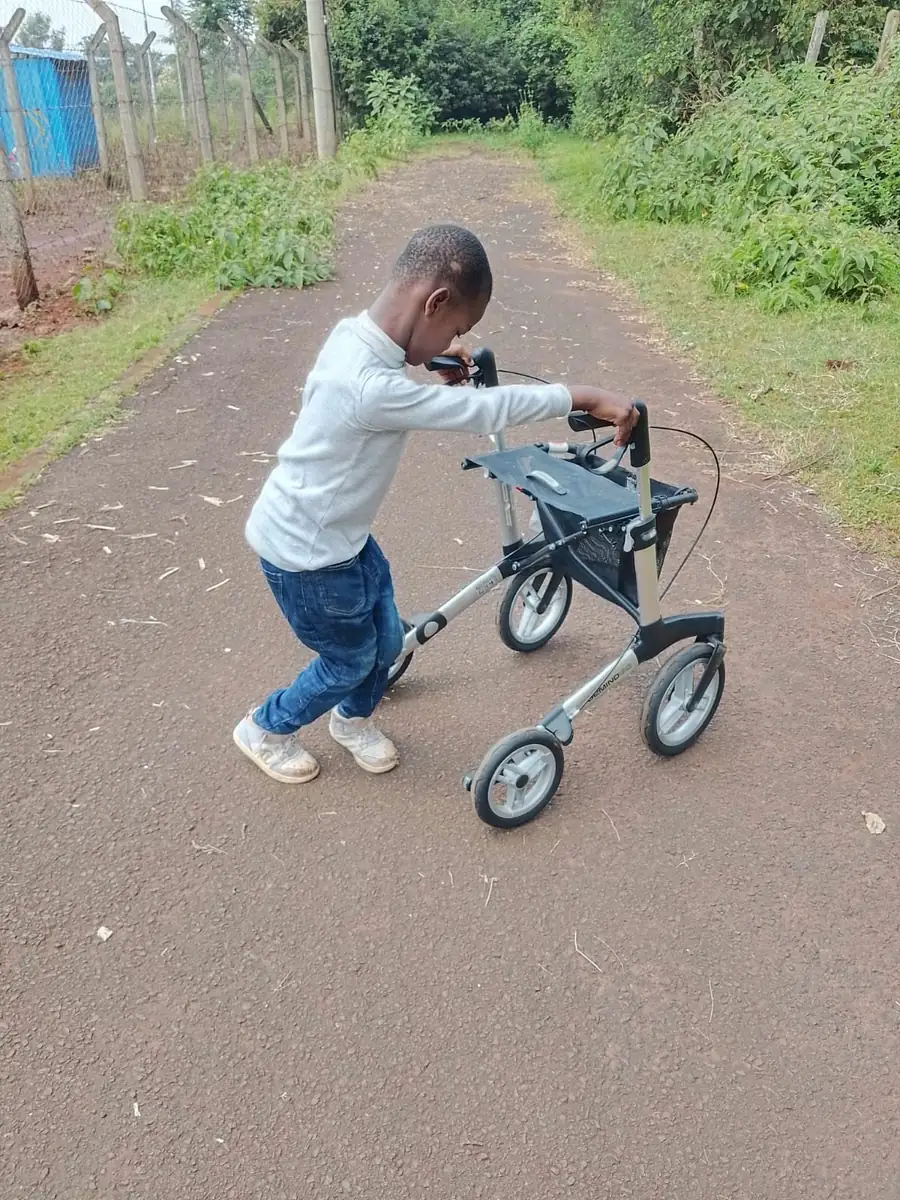
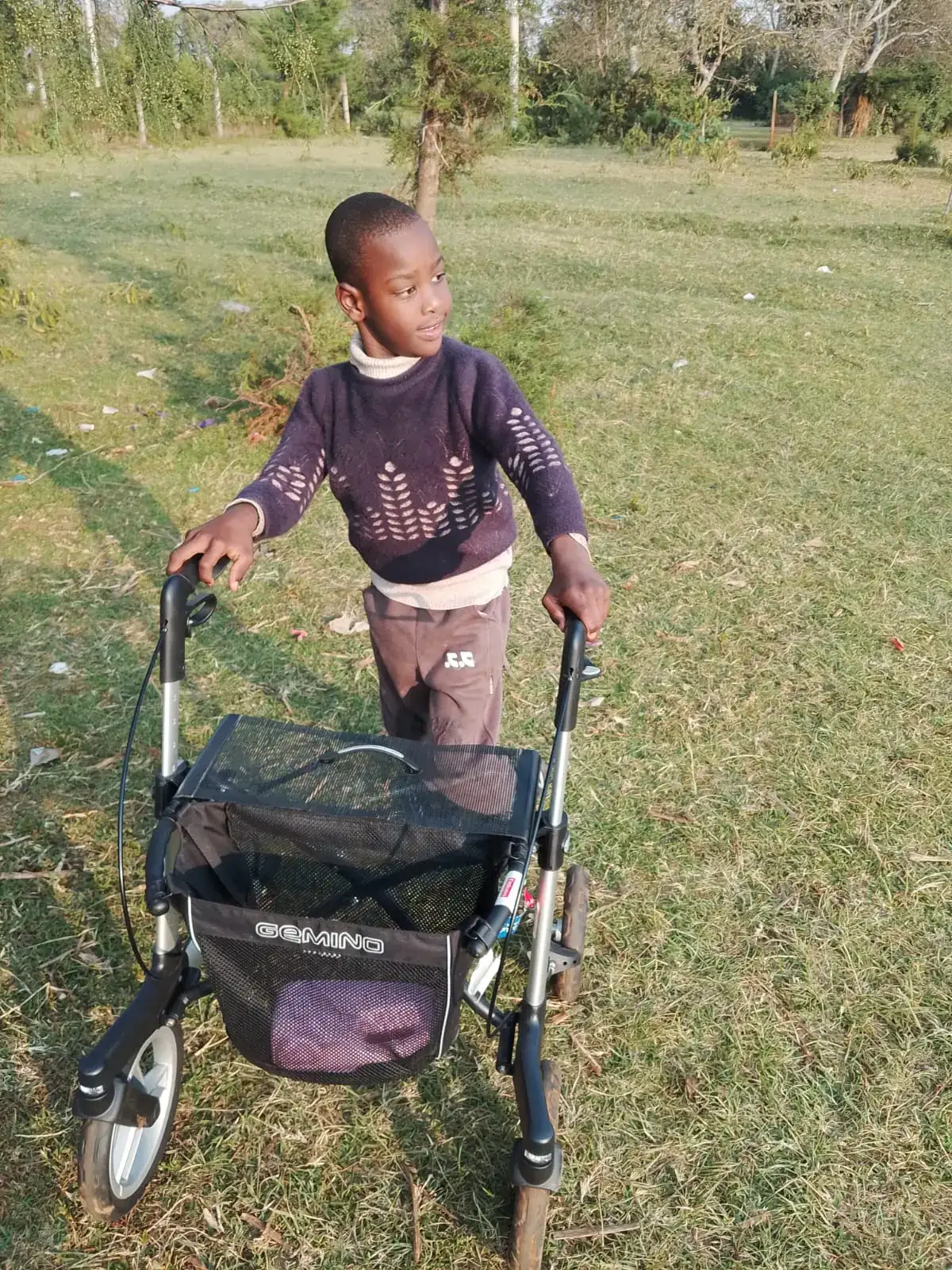
Ian is 8. He was born with a disability and severe leg deformities. Before the rollator, his walker had to be lifted with every step — slow, tiring, and limiting.
At APDK, with Bernard (APDK Workshop Manager) present, Ian tried the BHK outdoor-adapted rollator for about an hour. He tried walking, turning, sitting and standing. He fell, he got up. He continued.
APDK attribution: the rollator Ian used was donated by BHK Solutions Kenya to APDK for the pilot programme. It was not purchased, and its use during this first hour — and in the follow-up photographs at home — was documented for programme evaluation only.
The rollator's large wheels and stable frame let him push continuously across grass and paths, without lifting. Since that first hour, Ian has continued to use the rollator at home, outdoors on uneven, unpaved ground, on the path near the house and across open grass.
We share Ian's story with care, not as a triumphant marketing moment, but as an honest record of what we have observed, at APDK and at home.
“Be bless so much we truly appreciate your kind heart.”
Why this pilot matters
Evidence from the field — what the pilots prove
The Ian and Pricila pilots are not marketing stories. They are documented observations from real users, under real conditions, with professional and family feedback. Expand each card to see the evidence behind the claim.
Pilot in practice
What APDK evaluated — and what the feedback changed
During the pilot programmes, APDK rehabilitation professionals assessed the rollator against the same criteria they apply when recommending mobility aids to their own clients. Expand each card to see what was evaluated and what came out of the feedback.
What APDK evaluated
- Handle height range against the user's standing posture and arm length.
- Whether adjustment could be made quickly, without tools, by staff or family.
- Whether the fitted position kept the user upright rather than leaning forward.
What came out of the feedback
APDK confirmed the adjustable handle height covered both a child user and an adult user from the same frame.
The feedback confirmed tool-free adjustment as a requirement for the commercial specification, so that families — not only workshops — can set the rollator up correctly.
What APDK evaluated
- Resistance to tipping when the user put weight on the frame or the seat.
- Behaviour of the mechanical brakes on slopes and loose ground.
- Whether the user could recover and continue after losing balance.
What came out of the feedback
The frame stayed stable through turning, sitting and standing, and Ian was able to get up and continue after falling during his first hour.
APDK's feedback confirmed mechanical brakes and a wide, low-tipping stance as non-negotiable features for outdoor Kenyan use.
What APDK evaluated
- Rolling resistance on grass, paths and unpaved, uneven ground.
- Turning radius in narrow indoor spaces and doorways.
- Whether the user had to lift the rollator at any point.
What came out of the feedback
Ian moved continuously outdoors without lifting the rollator — the decisive difference from his previous walker.
The feedback confirmed the large polyurethane wheels for rough ground while keeping the frame narrow and nimble enough for indoor use, so one product serves both settings.
What APDK evaluated
- Confidence and willingness to keep moving during the first hour.
- Effort required per metre compared with the user's previous walking aid.
- Whether use continued at home, unsupervised, weeks later.
What came out of the feedback
Use continued at home, documented by Ian's mother Peris without BHK or APDK staff present — evidence the rollator was useful enough to keep using.
The integrated seat proved essential: resting on the spot rather than turning back is what extends how far a user can actually go.
What APDK evaluated
- Wheel tread, brake function and frame joints after extended outdoor use.
- Whether wearing parts can be replaced without specialist equipment.
- Suitability of the folding aluminium frame for transport and storage.
What came out of the feedback
After more than two years of daily outdoor use by Pricila, 85, wheels, brakes and frame were reported in very good condition as of June 2026.
APDK's feedback made local repairability an explicit design principle: replaceable wheels and brake parts, so a worn component never means a discarded rollator.
The rollator assessed was donated by BHK Solutions Kenya to APDK for the pilot programme, not purchased. The evaluation is professional and observational, and is not a controlled clinical trial.
Design principles
Why every choice matters.
Built for Kenyan terrain
Designed for uneven, unpaved and rough ground across Kenya — and therefore even easier to use on smooth, level surfaces.
Repairable locally
Mechanical, not electronic. Brake cables, wheels and normal wear parts should be straightforward to replace in Kenyan workshops, so the rollator keeps working instead of being replaced.
Made to last
Aluminium frame, polyurethane wheels and high-quality bearings. Durability is part of sustainability: a longer working life means lower lifetime cost, less material used and less waste.
Investor FAQ
Common questions from investors and partners
Answers about how the pilots were run, what they proved, the APDK partnership, commercial goals and the next steps toward certification and launch.
Two pilot programmes were run through the Association for the Physically Disabled of Kenya (APDK). The rollator was donated to APDK and used by real participants under everyday Kenyan conditions — outdoors on grass, paths and unpaved ground. APDK rehabilitation professionals observed fit, stability and manoeuvrability, while caregivers provided follow-up photographs and feedback from home use.
The pilots demonstrated that an outdoor-adapted rollator can deliver sustained mobility improvement under Kenyan conditions. Key findings include: continuous outdoor use for more than two years by one user; very good wheel, brake and frame condition after that period; independent daily use documented at home by caregivers; and positive professional assessment from APDK staff.
BHK Solutions Kenya aims to introduce an established mobility category — the outdoor-adapted rollator — into a Kenyan market where it remains largely absent. The initial focus is Kenya, followed by neighbouring East African markets, through rehabilitation centres, healthcare providers, NGOs, distributors and direct-to-consumer sales.
APDK is BHK Solutions Kenya's pilot partner. APDK provided rehabilitation expertise, structured evaluation and access to users who could test the rollator in real-world conditions. The relationship is a pilot partnership, not a commercial distribution agreement.
The next major milestone is KEBS certification of the commercial model for the Kenyan market. Once certified, BHK Solutions Kenya will begin commercial supply to rehabilitation organisations, healthcare providers, NGOs, distributors and families. The company is also preparing investor and distribution discussions to support the launch phase.
Not yet. The model shown is the pilot unit used for evaluation. The commercial version will be adapted for the Kenyan market and must pass KEBS certification before launch. Pre-orders and investor enquiries can be registered now via the Contact and Investor Brief pages.