

Fitting and adjustment
Handle height, seat position and grip adjusted for each user by APDK rehabilitation staff.
Adjustment range covered both an 85-year-old adult and an 8-year-old child.
APDK fitting notes — document placeholder
Pilot programmes
Two participants. More than two years of continuous outdoor use under real-life conditions, documented through interviews and first-hand experience. Their stories, their experiences and the results are presented openly on this page — with consent and with respect for the people who made this pilot possible.
Pilot one
Pricila, 85, has used a BHK rollator for for more than two years — through daily walks, seasonal weather and the ordinary wear that no laboratory can simulate.
Her rollator remains in very good condition. Wheels roll true and appear as new.. Brakes hold., no adjustsment needed The frame is intact. The seat has carried her through many rests.
Her use is our longest single record — the ground truth behind every claim we make about durability and repairability.
PRICILA — PHOTOGRAPH AT APDK WORKSHOP NAIROBI
Pilot two
Ian is 8. He was born with a disability and severe leg deformities. Before the rollator, his walker had to be lifted with every step — slow, tiring, and limiting.
At APDK, with Bernard (APDK Workshop Manager) present, Ian tried the BHK outdoor-adapted rollator for about an hour. He tried walking, turning, sitting and standing. He fell, he got up. He continued.
APDK attribution: the rollator Ian used was donated by BHK Solutions Kenya to APDK for the pilot programme. It was not purchased, and its use during this first hour — and in the follow-up photographs at home — was documented for programme evaluation only.
The rollator's large wheels and stable frame let him push continuously across grass and paths, without lifting.
Since that first hour, Ian has continued to use the rollator at home, outdoors on uneven, unpaved ground, on the path near the house and across open grass, as the photographs below show.
We share Ian's story with care, not as a triumphant marketing moment, but as an honest record of what we have observed, at APDK and at home.
Caregiver testimony
“Ian is completely dependent on the rollator — he simply cannot walk without it.”
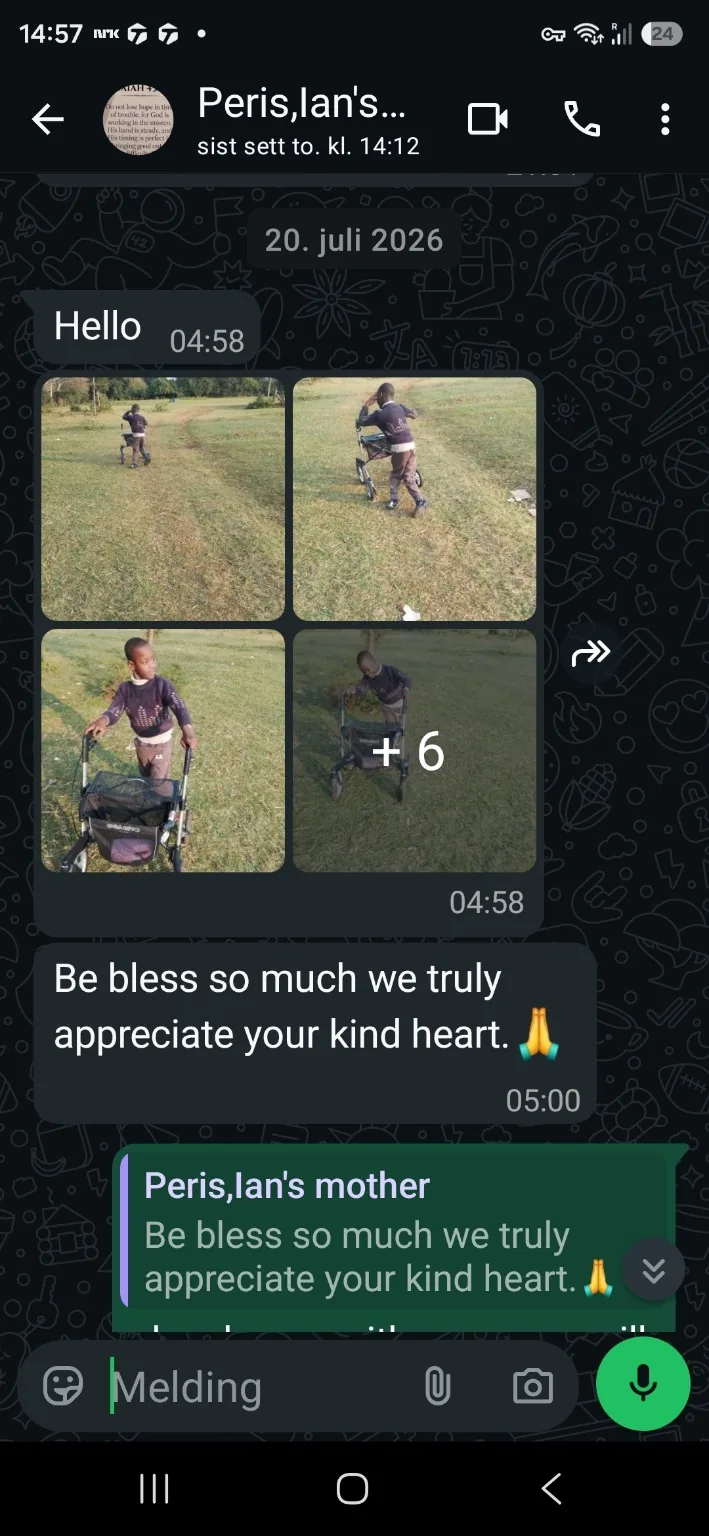
Ian — at APDK and at home on uneven ground
Pilot gallery
All photographs are shared with consent and documented during the pilot programme at APDK and in the users' own surroundings.
Showing 11 of 11 photographs.
Pilot timeline
June 2024
Pricila, 85, receives an outdoor-adapted rollator for daily use in ordinary Kenyan conditions.
2024 – 2025
Daily walks through seasonal weather, unpaved paths and uneven ground, documented through interviews and photographs.
2025
A rollator is donated to APDK for the pilot programme, enabling professional rehabilitation assessment.
2025
Ian, 8, tries the rollator at APDK with the workshop manager present: walking, turning, sitting and standing.
2025 – 2026
Ian continues daily outdoor use at home on grass and unpaved paths, followed up by his family.
June 2026
Wheels, brakes, frame and seat reviewed after more than two years of use and reported in very good condition.
Technical evaluation
Each area below was observed during the pilot programme. Formal documents are being prepared; the placeholders show what will be published once finalised.
Handle height, seat position and grip adjusted for each user by APDK rehabilitation staff.
Adjustment range covered both an 85-year-old adult and an 8-year-old child.
APDK fitting notes — document placeholder
Mechanical brakes and frame stability observed on slopes, grass and uneven ground.
Brakes held after two years with no adjustment required.
Brake and stability check sheet — document placeholder
Turning, doorway passage and indoor movement assessed alongside outdoor use.
Large wheels allowed continuous pushing outdoors while remaining manageable indoors.
Manoeuvrability observation log — document placeholder
Wheels, tread, frame joints and seat inspected after more than two years of outdoor use.
Wheels roll true, frame intact, no structural repairs needed.
Two-year condition report — document placeholder
Interviews with the users and their families about confidence, independence and daily routine.
Both users reported increased independence in everyday outdoor movement.
User interview summary — document placeholder
Availability of spare parts and the feasibility of local repair reviewed with the APDK workshop.
Standard parts and simple tools are sufficient for local servicing.
Service and spare-part list — document placeholder
Pilot results are qualitative and observational. They document real use over time, not a controlled clinical trial.